
🌍 Aid Money Meets Stablecoins
The institution that pays for roads, clinics, and power grids in poorer countries is now eyeing a crypto rail.

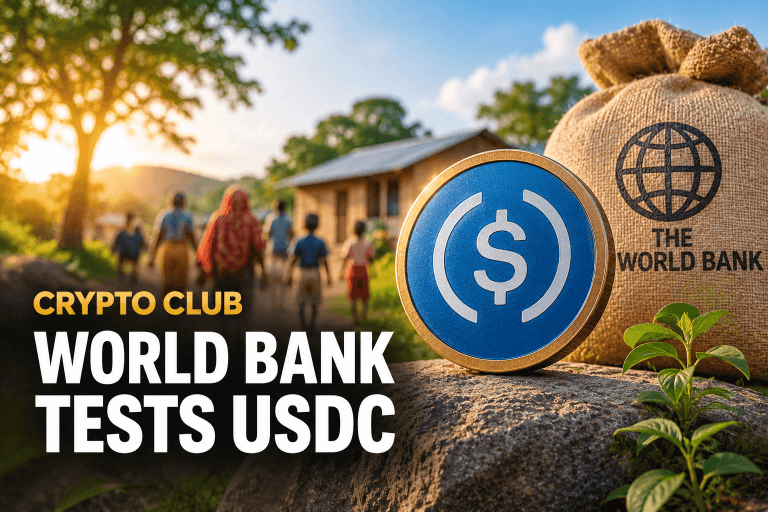
On November 17, the World Bank Group said it will explore using regulated dollar stablecoins to move its money, according to its official press release. It's working with two partners: Citi, one of the biggest U.S. banks, and Circle, the company behind the USDC stablecoin.

The goal is simple to state. Get development money to the people who need it faster, more cheaply, and with a clearer view of where it goes.

The scale is what makes this news. The World Bank Group committed $123.5 billion in loans, grants, equity investments, and guarantees in the fiscal year that ended June 30, 2026, Cryptowisser reported. Even a small slice of that moving on-chain would be a major test for stablecoins.
🏦 Why the Old System Is Slow
Today, the World Bank pays out through correspondent banking. That's the chain of banks that pass money from one country to another, each one holding it for a while and often taking a cut.

It works, but it's slow and closed on weekends. A payment can sit for days while it moves through several institutions.

The World Bank wants to see whether stablecoins can work alongside that system or improve on it. A stablecoin is a digital token pegged to a currency, in this case the U.S. dollar. USDC moves on public blockchains that run 24/7.

World Bank Group President Ajay Banga framed it as fixing development's financial plumbing. His examples were practical: a health clinic built on time, or a farmer paid before harvest season ended.

The press release makes the money case bluntly. Development lenders face tighter budgets even as the problems they tackle get bigger. Small efficiency gains, repeated at scale, could free up real money for actual projects.
🔧 Citi Brings the Banks, Circle Brings the Coins
Each partner brings one half of the bridge.

Citi brings its existing connections to traditional banking rails. Shahmir Khaliq, Citi's head of services, said the bank's network reaches more than 180 jurisdictions and can deliver 24/7 payment capabilities at scale.

Circle brings the crypto side, with the infrastructure to mint and settle funds in USDC. Circle CEO Jeremy Allaire said money that moves at internet speed shouldn't be reserved for the biggest banks and corporations, Decrypt reported.

The first phase will test what the World Bank calls an intermediated and interoperable payment model. Put simply, regulated go-betweens like Citi would connect the stablecoin to bank accounts on each end. The World Bank wouldn't be handing tokens straight to recipients.

The project builds on FundsChain, a World Bank blockchain platform that already tracks how project money is spent. It has onboarded more than 350 projects across 96 countries. That figure describes FundsChain's reach today, not the countries that will use USDC, CoinMarketCap noted.
📈 A Big Week for USDC
The timing helps Circle. A day after the World Bank news, Circle teamed up with DBS, Southeast Asia's largest bank by assets. Eligible institutional clients in Asia can now mint and redeem USDC directly through DBS, around the clock, CoinDesk reported.

Corporate demand is real. A DBS survey of 422 business and finance leaders across 11 markets found that 88% of large corporations were already using or piloting some form of tokenized money.

Put the two deals together and USDC gets something it has chased for years: direct pipes into big, regulated institutions.

It still trails Tether by a wide margin. CoinGecko data shows USDC's market value sat near $68.3 billion on November 19, against about $175.1 billion for Tether's USDT. One analyst told CoinDesk the DBS deal alone won't close that gap, since USDT's strength in Asia comes from exchange trading and payments in emerging markets.

Circle has also had a mixed few weeks. It just reported a profitable quarter while its share of the stablecoin market slipped.
⚠️ What Hasn’t Been Decided
This is an exploration, not a launch. Plenty is still blank.
The World Bank hasn’t said how much money will move in USDC, when the first payment will happen, or which blockchain it will use. It also hasn’t named the countries involved. The first phase will only include borrower countries where using digital assets is allowed.
Several of the World Bank’s borrower countries restrict or ban crypto, and some have strict capital controls. That could shrink the pool of countries where this can work.
There’s also the last mile. Someone on the receiving end still has to turn USDC into local currency. That step depends on local banks, local rules, and local fees, none of which the World Bank has addressed yet.
🎯 Final Takeaway: Stablecoins Get a Development Test
The World Bank isn't a crypto startup trying to look modern. It's one of the most cautious institutions in global finance. When it says stablecoins deserve a serious look, that carries weight no marketing budget can buy.

It also fits a wider pattern. Big banks are funding their own stablecoins, and payment giants like Zelle are moving onto public blockchains.

For everyday crypto holders, nothing changes overnight. USDC holds its $1 value either way.

Watch for the first named country and the first real payment. That's when an announcement becomes proof that stablecoins can carry aid money where it needs to go.
Sources
- https://www.worldbank.org/en/news/press-release/2026/11/17/world-bank-group-explores-regulated-stablecoins-to-modernize-payments-redirect-res
- https://decrypt.co/383485/world-bank-circle-citi-test-stablecoins-development-payments
- https://coinmarketcap.com/academy/article/world-bank-circle-usdc-stablecoin-payments
- https://www.cryptowisser.com/news/world-bank-tests-usdc-to-speed-up-payments-in-96-countries/
- https://www.coindesk.com/business/2026/11/18/circle-turns-to-dbs-as-banks-build-rival-digital-payment-systems-across-asia
- https://www.coingecko.com/en/coins/usdc
Crypto Club and Mode Mobile communications are for informational purposes only, and are not a recommendation, solicitation, or research report relating to any investment strategy, security, or digital asset. All investments involve risk including the loss of principal and past performance does not guarantee future results.
Any information contained in this commentary does not purport to be a complete description of the securities, markets, or developments referred to in this material. The information has been obtained from sources considered to be reliable, but we do not guarantee that the foregoing material is accurate or complete. There is no guarantee that any statements or opinions provided herein will prove to be correct.
Get fresh insights, breaking news, and hidden gems in the world of crypto—delivered straight to your inbox with our Crypto Cookies newsletter.
Don’t miss out—sign up now and get your first bite of insider knowledge!