
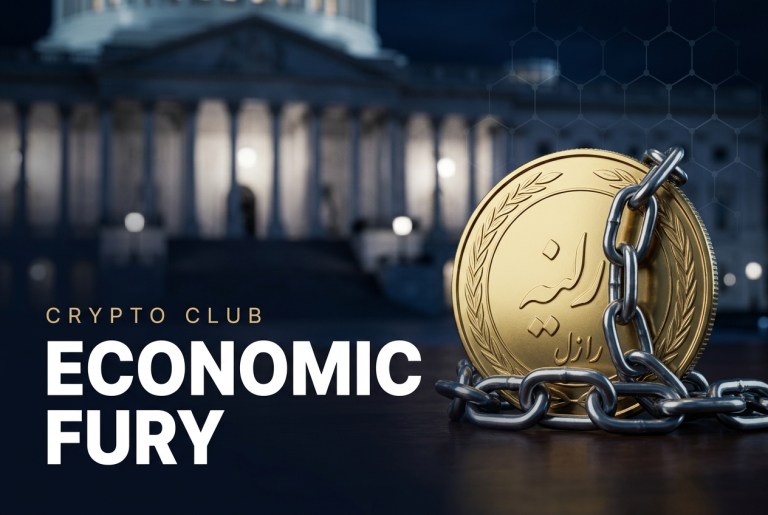

🚨 A Major Enforcement Action Lands on Iran’s Crypto Hub
The U.S. Treasury’s Office of Foreign Assets Control has launched a sweeping sanctions campaign called “Economic Fury” targeting Nobitex and several other Iranian cryptocurrency exchanges. Nobitex holds an outsized position in Iran’s digital economy, processing more than 50 percent of all Iranian digital asset inflows in 2025 and claiming a user base of over 11 million people. The action marks one of the most aggressive enforcement moves ever taken against a country’s domestic crypto infrastructure. OFAC designated Nobitex’s chairman and co-founder Amir Hossein Rad and its current CEO Seyed Ali Khoee as part of the same sweep, signaling that Washington is now willing to go after individuals running these platforms, not just the exchanges themselves. For investors and compliance professionals watching the space, this signals a new level of intensity in how regulators treat crypto as a sanctions-evasion vector. The message is clear: operating a crypto exchange that touches Iranian financial flows now carries significant legal risk, regardless of where that exchange is incorporated.
📊 The Scale of Nobitex’s Reach Inside Iran
Understanding why Nobitex became the primary target requires a look at just how dominant the platform had become. Iran’s crypto economy measured roughly $10 billion in volume during 2025, and Nobitex was processing the majority of that flow. The exchange functioned less like a typical retail trading venue and more like a critical piece of national financial infrastructure. Since Iran has been cut off from SWIFT and most international banking systems, digital assets have filled in as a practical alternative for businesses, ordinary citizens, and regime-linked actors alike. With the Iranian rial losing roughly 90 percent of its value since 2018 and inflation persistently running above 40 percent, Iranians have had strong incentives to hold dollar-linked stablecoins as a store of value. Nobitex became the on-ramp and off-ramp for much of that activity. Its reach into everyday Iranian financial life made it both a critical economic tool for millions of ordinary users and a strategic target for the U.S. government seeking to cut off regime financing.
🔗 Terrorism Finance and IRGC Ties
The Treasury’s designation is built on documented links between Nobitex and Iran’s Islamic Revolutionary Guard Corps. According to OFAC, the exchange facilitated transactions for IRGC-affiliated ransomware actors and allowed OFAC-designated IRGC operatives to use the platform. The IRGC has relied on crypto mining, ransomware proceeds, and exchange access to fund a network of proxy organizations including Hezbollah, Hamas, and the Houthis. Nobitex reportedly processed payments moving between the IRGC Quds Force and these groups, acting as a connective layer in a broader illicit finance network. Following U.S. military operations in Iran in 2025, the exchange also reportedly played a role in shielding and moving assets out of the country on behalf of regime insiders. That timing is significant: it suggests Nobitex wasn’t a passive bystander but an active participant in protecting regime wealth during a moment of geopolitical crisis. Those facts gave Treasury strong legal footing to act under Executive Orders 13224 and 13902.
💵 How Iran Used Stablecoins to Shore Up the Rial
One of the more striking revelations in the Treasury action is the role Nobitex played in helping the Central Bank of Iran acquire hundreds of millions of dollars’ worth of stablecoins. According to blockchain analytics firm Elliptic, the Central Bank made two large USDT purchases in April and May 2025, with the funds routed through Nobitex and used to prop up the value of the Iranian rial. The strategy effectively created a parallel dollar-backed reserve system that sat entirely outside the reach of Western regulators. When Nobitex was hacked in June 2025 for over $90 million, those USDT reserves were quickly converted into other crypto assets and scattered across multiple blockchains in an apparent bid to preserve value after the breach. Tether later froze addresses with Iranian exposure, pushing users toward DAI on Polygon as an alternative. For investors paying attention to stablecoin regulation debates, this episode illustrates the challenge: stablecoins are easy to acquire, hard to fully trace, and highly effective as a sanctions buffer.
🌐 A Broader Web of Designated Exchanges
Nobitex was not the only target in the Economic Fury campaign. OFAC also sanctioned Wallex, Iran’s second-largest digital asset exchange with roughly 12 percent of the country’s digital asset inflows in 2025, and Bitpin, which handled another 10 percent of Iranian inflows and whose investors have been linked to U.S. sanctions evasion efforts. Earlier in 2026, OFAC had designated Zedcex and Zedxion, two UK-registered exchanges that TRM Labs connected to roughly $1 billion in IRGC-linked stablecoin flows. That January 2026 action was notable as the first-ever OFAC designation of IRGC-linked digital asset exchange infrastructure. Together, these actions point to a coordinated enforcement strategy that is methodically working through Iran’s entire crypto ecosystem, targeting not just obvious bad actors but the full chain of exchange infrastructure that enables sanctions evasion to function at scale.
🎯 What This Means for Crypto Investors and Exchanges
For crypto traders and investors outside Iran, the most immediate takeaway is a compliance warning. Any exchange that has processed transactions routed through Nobitex, Wallex, Bitpin, or the Zedcex network now faces elevated due-diligence obligations. OFAC has made clear that designating exchange wallet addresses, not just corporate entities, is now part of its enforcement toolkit, which puts the burden on global platforms to screen counterparties more aggressively. Blockchain analytics firms are already tracking the downstream flows, and retroactive exposure is a real risk for exchanges that moved slowly on Iranian transaction screening. For investors, the broader lesson is that geopolitical risk in crypto is not theoretical. Regulatory actions of this scale can freeze assets, disrupt liquidity, and create compliance liability across the entire ecosystem. Exchanges with strong KYC and transaction monitoring will be better positioned to avoid collateral damage. The Economic Fury campaign makes it harder for Iran’s parallel financial system to function, but it also raises the compliance bar for every platform operating in markets with significant Iranian diaspora populations.
Sources
https://home.treasury.gov/news/press-releases/sb0519
https://www.theblock.co/post/403436/us-sanctions-nobitex-iranian-crypto-exchanges-economic-fury-campaign
https://www.elliptic.co/blog/inside-nobitex-how-irans-largest-crypto-exchange-fuels-sanctions-evasion-and-illicit-finance
https://www.trmlabs.com/resources/blog/ofac-sanctions-crypto-addresses-associated-with-the-central-bank-of-iran-freezes-usd-344-million
https://www.trmlabs.com/resources/blog/ofac-sanctions-zedcex-and-zedxion-in-first-ever-designation-of-an-irgc-linked-digital-asset-exchange
https://www.trmlabs.com/resources/blog/irans-crypto-economy-in-2025-declining-volumes-rising-tensions-and-shifting-trust
https://www.binance.com/en/square/post/35393246062986
Crypto Club and Mode Mobile communications are for informational purposes only, and are not a recommendation, solicitation, or research report relating to any investment strategy, security, or digital asset. All investments involve risk including the loss of principal and past performance does not guarantee future results.
Any information contained in this commentary does not purport to be a complete description of the securities, markets, or developments referred to in this material. The information has been obtained from sources considered to be reliable, but we do not guarantee that the foregoing material is accurate or complete. There is no guarantee that any statements or opinions provided herein will prove to be correct.
Get fresh insights, breaking news, and hidden gems in the world of crypto—delivered straight to your inbox with our Crypto Cookies newsletter.
Don’t miss out—sign up now and get your first bite of insider knowledge!