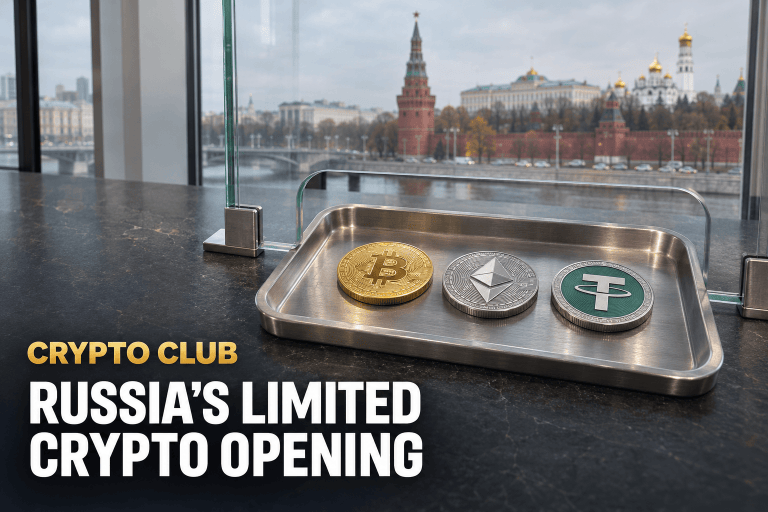

🇷🇺 The Door Opens on November 17
For the first time, ordinary Russians can buy crypto through the country's own regulated system.

Starting November 17, licensed Russian firms can offer bitcoin, ether, and Tether's USDT to non-qualified investors, the legal term for everyday retail buyers, Cointelegraph reported. The Bank of Russia finalized the rules on November 6.

Purchases run through regulated middlemen: brokers, asset managers, and licensed crypto exchange providers. Trades can happen on an exchange or over the counter, CoinPaprika reported.

It's a major shift for a country that long treated crypto as a problem to contain rather than a product to sell to savers.

The groundwork moved fast. President Vladimir Putin signed the underlying law, Federal Law No. 282-FZ, on August 4. The central bank published its first list of approved coins a week later, and the law took effect on September 1.
💰 The 300,000 Ruble Ceiling
Retail buyers get access, but only a small share.

Non-qualified investors can buy up to 300,000 rubles of crypto a year, about $3,700, through each intermediary, FinanceFeeds reported. The cap counts the total ruble cost of everything bought through one broker or platform in a calendar year.

Because the cap applies per intermediary, an investor with accounts at several brokers could buy more overall. Most reports describe it this way, though CryptoTicker noted some sources read it as a cap per asset instead.

Qualified investors, who must meet higher wealth or experience thresholds, face no cap at all. They can buy any crypto asset traded on exchanges or over the counter.

Nobody skips the exam. Retail and qualified investors alike must pass a knowledge test and review risk materials before their first trade.
🪙 Why Only Three Coins Made the Cut
The central bank intentionally kept the menu short.

To qualify, a coin needs a large market value, high daily trading volume, and at least five years of price history on foreign exchanges. According to the regulator's announcement, TASS reported, only bitcoin, ether, and USDT qualified. The Bank of Russia said sticking to the most liquid coins protects retail buyers from sharp, unpredictable price swings.

First Deputy Governor Vladimir Chistyukhin said the bank has no plans to widen the list for now, CryptoTicker reported. XRP, Solana, and everything else remain off-limits for retail.

USDT is the awkward pick. Tether's dollar token is by far the largest stablecoin, but Tether follows U.S. sanctions and has frozen millions of USDT tied to sanctioned Russian exchanges in the past. Russians can now hold it legally at home, while the company behind it answers to Washington's rules.
🏦 Who Will Actually Sell It
Don't expect a flood of buyers on day one.

Licensed exchanges can begin organized crypto trading from November 22, once the central bank approves their trading rules, Cryptopolitan reported. More than 20 organizations already hold licenses as crypto exchanges or digital depositories, the firms that record who owns what. The central bank is still registering more operators, so the list of places to buy could grow over the coming weeks.

The heavyweights are aiming for December. Moscow Exchange plans to start pilot trading in bitcoin, ether, and USDT on December 1. Sberbank, Russia's largest bank, is targeting the same date after winning approval in October to offer crypto exchange services.

Moscow Exchange has already mapped out its market. Trading will run from 6:50 a.m. to 11:50 p.m. Moscow time, with same-day and next-day settlement, and a partner digital depository will record ownership, FinanceFeeds reported.

Sberbank and VTB together serve roughly 140 million banking clients, CryptoTicker noted. That's where the reach comes from. Crypto would sit inside banking apps most Russians already open every day.
🔒 The Walls Around the Market
Access comes with tight fences.
Crypto bought in the regulated market stays there. According to the Bank of Russia, as reported by both Cointelegraph and FinanceFeeds, moving coins from a regulated account to a self-custody wallet is banned. From July 1, 2027, the law will outlaw direct peer-to-peer crypto trading between individuals, and residents will have to go through authorized operators.
Paying for everyday goods and services with crypto inside Russia stays banned. The law does carve out exceptions, including settlements under foreign trade contracts between Russian residents and foreign partners, TASS reported. That carve-out matters for companies facing tight limits on cross-border payments.
Sanctions hang over everything. Moscow Exchange has been under U.S. sanctions since June 2024, and Cryptopolitan noted that some newly licensed firms also face Western sanctions. That makes it harder for this market to plug into global exchanges and liquidity.
🎯 Final Takeaway: Crypto Access on the State’s Terms
Russia isn't throwing crypto open the way a free market would. It's pulling crypto activity onto platforms the state can see and supervise.

The cap is small, so Russian retail money alone is unlikely to move bitcoin's price. The bigger change is structural. Trading that used to happen through peer-to-peer deals and offshore platforms is being steered onto licensed, state-watched rails.

Demand is the open question. Strict caps, mandatory tests, and a ban on withdrawals to private wallets could keep many users on the informal channels they already use. That pull may last until the peer-to-peer ban lands in 2027.

The first real signal arrives on December 1, when Moscow Exchange and Sberbank plan to switch on trading. After that, watch two things: how quickly retail accounts hit the cap and whether the central bank adds a fourth coin.
Sources
- https://tass.com/economy/2171441/amp
- https://cointelegraph.com/news/russia-finalizes-crypto-trading-rules-november-rollout
- https://financefeeds.com/russia-sets-3700-annual-crypto-purchase-limit-for-retail-investors/
- https://coinpaprika.com/news/russia-opens-bitcoin-ether-usdt
- https://www.cryptopolitan.com/russia-exchange-crypto-trading-in-november/
- https://cryptoticker.io/en/russia-retail-crypto-trading-bitcoin-ethereum-usdt-november-17/
Crypto Club and Mode Mobile communications are for informational purposes only, and are not a recommendation, solicitation, or research report relating to any investment strategy, security, or digital asset. All investments involve risk including the loss of principal and past performance does not guarantee future results.
Any information contained in this commentary does not purport to be a complete description of the securities, markets, or developments referred to in this material. The information has been obtained from sources considered to be reliable, but we do not guarantee that the foregoing material is accurate or complete. There is no guarantee that any statements or opinions provided herein will prove to be correct.
Get fresh insights, breaking news, and hidden gems in the world of crypto—delivered straight to your inbox with our Crypto Cookies newsletter.
Don’t miss out—sign up now and get your first bite of insider knowledge!