
What is it?
Let’s be honest: most airdrops right now want you to spend real money. Buy this token, deposit into this vault, bridge to this chain. That’s fine when the project is solid, but it also means you’re putting capital at risk before you know what the reward is actually worth.
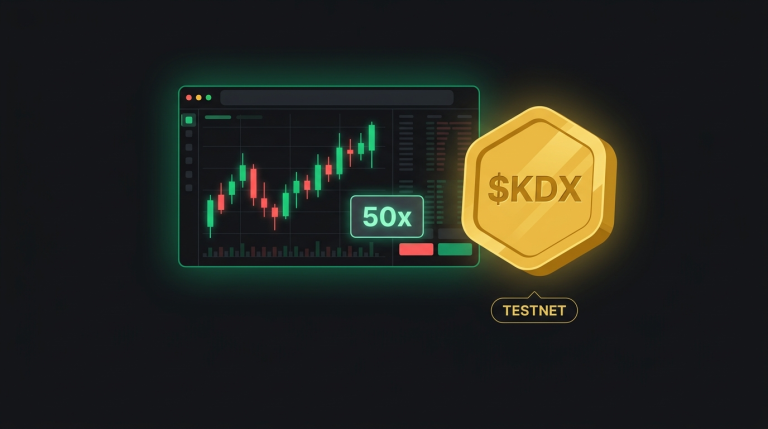
KieDex is different. It’s a crypto futures exchange currently running on testnet, which means everything you trade uses fake money. No deposits, no bridging, no token purchases. You sign up, get testnet USDT, and start trading BTC, ETH, DOGE, and TRX futures with up to 50x leverage. The platform distributes 100,000 $KDX tokens daily from an airdrop pool, split across active participants based on volume, profitability, and task completion.
KieDex recently closed a $3.5 million seed round led by Marqel Capital, with backing from Hidden Street Capital, Caviar, Kinetic Kollective (formerly CSP DAO), Solulu Club, Three Point Capital, Devmons, Rocket, and TaTaTu. The token isn’t live yet, so what you’re earning is a pre-TGE allocation. That’s speculative, but since the cost to participate is literally zero, the risk-to-reward ratio is hard to argue with.
How the airdrop works
The mechanics are unusual for the airdrop space because they actually reward skill, not just zombie clicking. Your final $KDX allocation is calculated from three weighted buckets:
- 50% from trading volume. Open and close positions on BTC, ETH, DOGE, and TRX perpetual futures. Volume on testnet USDT counts directly toward your score.
- 30% from PnL (profitability). This is the part that makes KieDex different. The platform tracks your paper trading PnL and rewards traders who actually make money. Spamming losing trades to inflate volume hurts your overall score.
- 20% from task completion. Daily missions, social actions, platform exploration, and limited-time campaigns round out the rest.
The reward pool refreshes every 24 hours: 100,000 $KDX is split across all eligible traders based on the weighted formula above. There’s no individual cap, so heavy users earn more in absolute terms, but the PnL component is a soft anti-Sybil measure since brand-new accounts spamming trades will tend to lose money.
To participate, you sign up at the KieDex testnet portal using either Google login or email, then connect a compatible wallet like MetaMask. There’s no KYC. You request testnet USDT from the in-app faucet and start trading immediately.
The math
There’s no public TGE date, no published total supply, and no seed valuation disclosed in the funding announcement. That makes any precise expected-value calculation impossible. What we can do is sanity-check the order of magnitude.
The daily pool is 100,000 $KDX. Assume the testnet runs for 120 days before TGE — a reasonable guess based on similar trade-to-earn campaigns. That’s a total airdrop allocation of roughly 12 million $KDX. If the project follows the standard pattern of allocating 5% to 10% of total supply for testnet rewards, total supply would land somewhere between 120 million and 240 million $KDX.
Now compare KieDex to its peers. dYdX trades around $0.50 to $0.70, Hyperliquid is well above $20, and most other futures-DEX governance tokens fall somewhere between $0.10 and $5 at TGE. Even at the low end — say $KDX launches at $0.10 — a daily pool of 100,000 tokens translates to roughly $10,000 in daily rewards spread across all active traders. If 5,000 active wallets share that pool, the median trader earns around $2 per day in pre-TGE allocation, with top performers earning materially more.
That’s not life-changing money. But it’s also free money for time you’d otherwise spend on Twitter. Active traders who score well across all three buckets — high volume, positive PnL, full task completion — could realistically end the campaign with a four-figure $KDX allocation if the token lists at the lower end of comparable valuations.
There’s an 8% referral bonus on top of all of this. You earn 8% of whatever your referrals claim, which is unusually generous for a free airdrop. Worth sharing if you have a network.
What we like
The “pay nothing, risk nothing” structure is the strongest feature. You aren’t bridging assets, locking up capital, or paying gas fees on a chain you’d rather not touch. The downside scenario is that you spend a few hours practicing leveraged futures trading on play money and walk away with nothing. That’s not a bad outcome.
The PnL-weighted scoring is genuinely novel and signals the team is trying to filter out Sybil farms. Most airdrops collapse under volume-only scoring because bots can simulate activity at near-zero marginal cost. A 30% PnL weight changes the incentive math: bots placing random trades will average roughly zero PnL minus fees, which means they bleed score over time. Real traders who can read a chart and size positions sensibly should outperform.
The investor list is solid for a project at this stage. Marqel Capital, Hidden Street, Caviar, and Kinetic Kollective (formerly CSP DAO) have meaningful track records in the DeFi and exchange space. The $3.5 million raise isn’t huge by 2026 standards, but it’s enough to signal real institutional interest without being so large that the cap table is suffocated by VC unlocks at TGE.
The leverage range is also a useful learning tool. Up to 50x exposure on testnet money is one of the safer ways to internalize how futures liquidations work. Most retail traders blow up their first real-money futures account because they don’t viscerally understand how fast a 50x position can move against them. KieDex lets you blow up a hundred testnet accounts before you ever risk a dollar.
What concerns us
The token isn’t live yet, and the TGE timeline is undefined. The biggest weakness here. There’s no published date, no announced exchange listings, and no public tokenomics document. Your earned $KDX is essentially an IOU until the team decides to launch — and that decision could slip by weeks, months, or quarters. Several testnet-to-TGE campaigns in the past 18 months have either delayed launches indefinitely or quietly wound down without distribution. The airdrop costs you nothing but time, but time is still time.
No pricing reference. Without published total supply, seed valuation, or FDV guidance, you can’t estimate what your earned $KDX is worth. Compare that to projects like WLFI or even smaller airdrops where the token is already trading and you can see exactly what each point of allocation is worth. KieDex is a black box on the reward side.
Concentration risk in the futures-DEX category. Hyperliquid, dYdX, GMX, Vertex, and a dozen other futures DEXes already dominate this category. KieDex is fighting for share in a saturated market with no obvious differentiation beyond the trade-to-earn flywheel. The team will need to convert testnet users into paying mainnet users at TGE, which is a famously hard transition. If the platform fails to attract real volume post-launch, $KDX value will reflect that.
Volume-and-PnL gaming is still possible. A 30% PnL weight makes Sybiling harder, but not impossible. Sophisticated farmers can run two correlated accounts that hedge each other, with one always winning by design. The team will need active anti-Sybil monitoring to keep the reward pool clean. Whether they have the resources for that at this stage is unclear.
Pre-TGE allocations get diluted at launch. Even if KieDex executes flawlessly, testnet rewards typically vest over several months post-TGE, often with linear unlocks. So the headline number in your dashboard isn’t necessarily what you can sell on day one. Read the tokenomics document carefully when it’s released.
The bottom line
This is one of the cleanest free airdrops on the market right now, and it’s also one of the most uncertain on the reward side. There’s nothing to spend, nothing to bridge, and no real risk to your principal. The cost of participation is the time you spend learning to trade futures on testnet — which has standalone educational value even if $KDX never lists.
For active traders who already enjoy chart-watching, this is a clear yes. The PnL-weighted scoring rewards skill, the 8% referral bonus is generous, and the investor list suggests the project is unlikely to vanish overnight. For passive farmers looking for a click-and-claim airdrop with a clear payout, the lack of TGE timeline and tokenomics transparency makes this harder to recommend.
The right play here is to spend a couple of hours setting up an account, posting some real trades you’d take with a real thesis, and then setting a recurring daily reminder to claim tasks and run a few positions. If you’re going to do it, do it consistently — the daily pool resets every 24 hours, so the traders who show up every day will compound their share materially.
Crypto Club Rating: 7/10