
🗳️ A Governance Proposal Becomes A $20 Million Heist
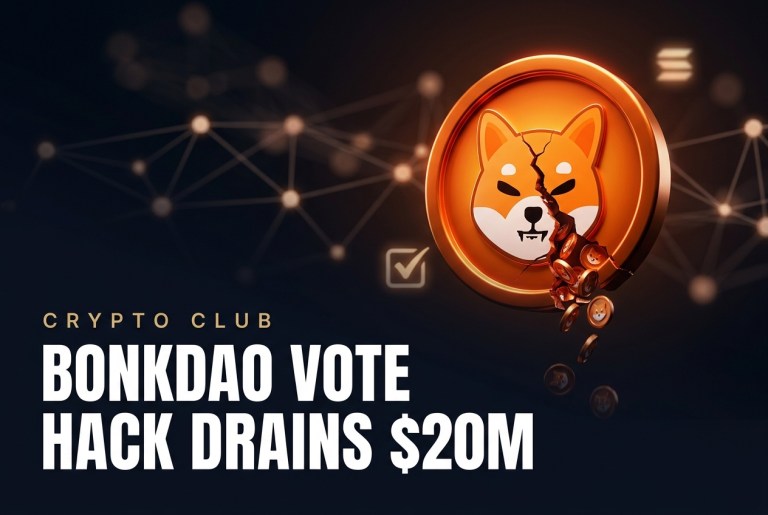
BonkDAO, the community treasury behind the Solana meme coin BONK, watched roughly $20 million in holdings disappear this week, and no one broke into anything. CoinDesk reported that an anonymous wallet submitted a proposal called BIP #76, titled “Sowellian BonkDAO,” on June 30, quietly asking the DAO to hand its treasury to a new wallet. Nothing about the submission looked unusual at first glance, and it sat unnoticed on the DAO’s forum for nearly a week before the real move began. For BONK holders and other DAO participants, the episode is a reminder that a treasury’s biggest threat is not always a coding flaw. Sometimes it is a proposal sitting in plain sight that simply needs enough votes, and votes, on many chains, can be purchased like any other asset if the price is right and turnout is thin enough to overpower.
💰 Buying Votes On Bybit And Binance
Between July 4 and July 5, a wallet linked to the attacker spent about $4.4 million buying BONK directly on Bybit and Binance, and reportedly borrowed additional tokens through DeFi lending markets to stretch its buying power further. That spending bought roughly one percent of BONK’s circulating supply, which happened to be exactly the quorum threshold BIP #76 needed to pass. For traders watching exchange order books, the purchases likely looked like routine accumulation rather than a coordinated takeover, since large meme coin buys happen constantly without raising alarms. That is precisely what made the strategy work. Exchange liquidity gave the attacker a fast, traceable but perfectly legal way to convert dollars into governance power, no smart contract exploit or bridge hack required, and no rule broken along the way that could trigger an automatic freeze.
⚖️ Quorum Cleared By The Slimmest Margin
The vote closed with 882.38 billion BONK in favor against an 879.95 billion token quorum requirement, a margin of roughly 0.3 percent. Just seven wallets voted out of a DAO membership reported at over 18,000, a 2.9 percent turnout that let one determined buyer effectively decide the outcome alone. There was no timelock delaying execution, no minimum multisig sign off, and no independent circuit breaker to pause a proposal moving an unusually large sum. Once the vote passed, roughly 4.43 trillion BONK, about five percent of total supply, moved automatically with no human review step in between. Protocol developers across DeFi have long flagged low turnout quorum voting as fragile, arguing that a fixed percentage threshold means almost nothing if most token holders simply never show up to vote, and BonkDAO’s structure became the latest case study in why that warning keeps resurfacing.
🏦 Draining The Treasury And Resurfacing As BONK 2.0
Within hours of the proposal executing on July 6, about $188,000 moved toward an exchange for conversion while the remaining roughly $19 million landed in a new multisig wallet. The Defiant reported the attacker then routed the funds into a freshly created entity styled as a “BONK 2.0” DAO, an attempt to launder the optics of the theft into something resembling a legitimate community treasury. Around the same time, the attacker began unwinding roughly $5.3 million of the BONK originally bought to secure the vote, locking in partial profit while still holding the bulk of the drained treasury. For investors, the sequence shows how quickly on-chain funds can be layered and repositioned once a governance exploit succeeds, often faster than exchanges or investigators can respond with a freeze request.
📉 BONK Price Slides As Confidence Wavers
BONK fell roughly 8 to 10 percent in the hours after the drain became public, extending losses as traders weighed how much of the token’s remaining treasury and community trust had been damaged. BonkDAO said it has identified the exchange wallets tied to the attack and is coordinating with Binance, Bybit, bridge operators, and the Solana Foundation to trace and potentially freeze the funds. Whether any of the $20 million is recoverable remains unclear, since every transaction in the sequence was technically valid under the DAO’s own rules. That distinction has fueled debate among industry participants over whether this counts as theft or simply a ruthless exploitation of governance design flaws that BonkDAO itself left open, a gray area that could complicate any legal or exchange-side recovery effort going forward.
🎯 Conclusion: Governance Risk Is Treasury Risk
The BonkDAO incident echoes the 2022 Beanstalk attack, where a flash loan briefly bought supermajority voting power to drain $182 million in a single transaction. BonkDAO’s version needed no flash loan, just patient exchange buying and a governance system with no timelock, no quorum floor tied to real participation, and no multisig checkpoint before a treasury-moving proposal executes. For investors and DAO members across the industry, the lesson is direct: a token’s governance mechanics are part of its risk profile, not a footnote. Projects holding meaningful treasuries without execution delays or emergency pause controls are exposed to the same math BonkDAO just learned the hard way. Traders should watch whether other DAOs move quickly to add timelocks and participation minimums, since exchanges make buying a majority vote easier than most communities assume.
Sources
https://www.coindesk.com/markets/2026/07/07/bonk-faces-usd20-million-treasury-drain-after-attacker-spends-usd4-million-to-pass-malicious-proposal
https://thedefiant.io/news/hacks/bonkdao-attacker-moves-19m-loot-into-new-bonk-2-0-dao
https://finance.yahoo.com/markets/crypto/articles/bonk-falls-8-governance-attack-151800572.html
https://beincrypto.com/bonk-dao-20-million-attack/
https://www.mexc.com/news/1197624
https://medium.com/immunefi/hack-analysis-beanstalk-governance-attack-april-2022-f42788fc821e
Crypto Club and Mode Mobile communications are for informational purposes only, and are not a recommendation, solicitation, or research report relating to any investment strategy, security, or digital asset. All investments involve risk including the loss of principal and past performance does not guarantee future results.
Any information contained in this commentary does not purport to be a complete description of the securities, markets, or developments referred to in this material. The information has been obtained from sources considered to be reliable, but we do not guarantee that the foregoing material is accurate or complete. There is no guarantee that any statements or opinions provided herein will prove to be correct.
Get fresh insights, breaking news, and hidden gems in the world of crypto—delivered straight to your inbox with our Crypto Cookies newsletter.
Don’t miss out—sign up now and get your first bite of insider knowledge!