
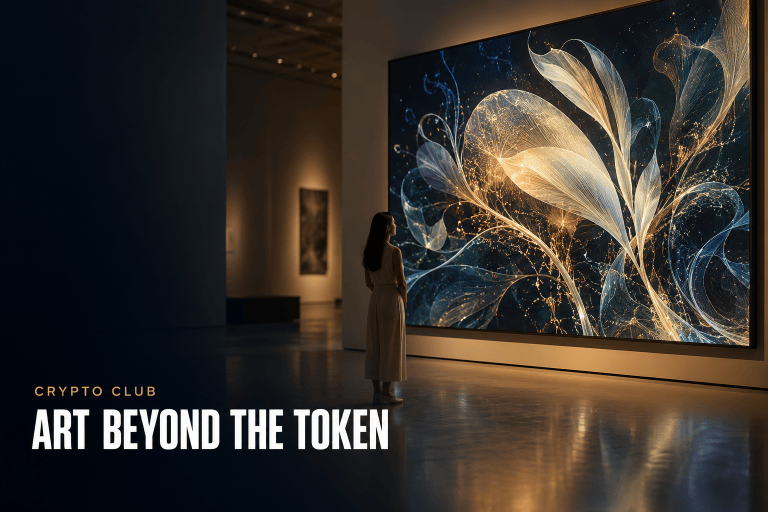

Before Monica Rizzolli made digital flowers, she learned printmaking. Her grandfather ran a print shop in São Paulo, and she studied woodcut and lithography at 15. Look at the sharp botanical lines in her Fragments of an Infinite Field series with that history in mind, and an older craft comes into focus.
LACMA included two works from the series as promised gifts in its 2023 announcement of the Cozomo de' Medici collection. The wider donation and pledge encompassed 22 works by 13 artists, which LACMA described as the first and largest private collection of blockchain artworks to enter an American art museum.
That makes the collection useful for understanding what happened to NFT art after the speculative frenzy cooled. Inside a museum, the token price is no longer the main attraction. The questions become more familiar ones about authorship, process, medium and what exactly a museum is preserving.
Flowers, pegs and an artist's decisions
Another promised gift, Dmitri Cherniak's Ringers #962, belongs to a series built around methods of winding a string around pegs. Code varies elements such as the number of pegs, their size and their colors, while Cherniak adjusts the algorithm that produces the compositions.
LACMA describes works like these as JPGs delivered as NFTs. The distinction matters. The NFT is the blockchain token associated with the artwork, not the image itself.
That token can establish provenance and ownership. It cannot explain why a flower or a loop of string is worth looking at. For that, the artwork still has to do the work.
At MoMA, the room entered the work
Refik Anadol's Unsupervised pushed that question further. For its 2022–2023 exhibition at MoMA, Anadol used artificial intelligence to interpret publicly available data from more than 200 years of works in the museum's collection.
The resulting installation generated images in real time. It also responded to conditions around MoMA's Gund Lobby, including lighting, movement, acoustics and outdoor weather. The surroundings became part of what appeared on the screen.
MoMA later acquired Unsupervised, making it the first tokenized artwork to enter the museum's collection. Its collection record lists custom hardware and software, artificial intelligence, color and sound, with variable dimensions.
That description points to a problem museums have increasingly had to solve with digital art. What exactly are they collecting?
For a painting, the answer is relatively straightforward. For a work generated by software, the museum may also need the code, hardware, display specifications and instructions required to keep the artwork functioning.
A video can't show you everything
That difference is easy to miss online. Anadol's studio explains that one real-time software work from the Unsupervised NFT collection is too computationally demanding to run in an ordinary web browser. The preview shown on Feral File is instead a recorded video.
The studio lists a custom computer, a 75-inch display and an artist-signed physical certificate alongside the work. Other pieces in the collection are fixed-length videos.
Those works can look similar when reduced to a moving rectangle on a laptop, but they are not necessarily the same kind of object. One may be a finished video. Another may be software continuously generating something new.
That is where museums give the NFT story a second life. During the boom, much of the conversation centered on wallets, scarcity and auction prices. Institutional collections have to confront a more durable set of questions about how digital artworks are authenticated, displayed and preserved when the artwork might include a token, a file, software and physical equipment all at once.
Before planning an in-person visit, check what is actually on view. A collection page or past exhibition doesn't guarantee that a work will be displayed when you arrive.
But the museum records themselves reveal something important. The NFT may record ownership on a blockchain. Preserving the art can be a much bigger job.
Sources
- LACMA: the Cozomo de' Medici gift and promised gifts
- MoMA: Refik Anadol's Unsupervised exhibition, 2022–2023
- MoMA: Unsupervised collection record
- Refik Anadol Studio: the Unsupervised project and formats