
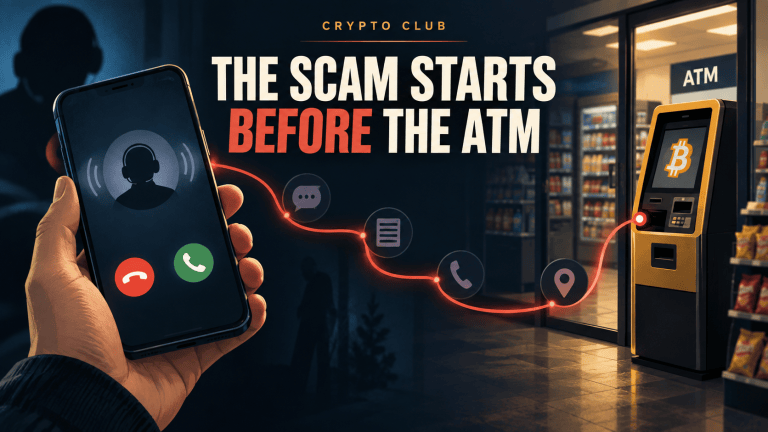

By the time a Michigan woman reached a Bitcoin ATM with thousands of dollars in cash, the scam had already been underway for hours.
It began with an email claiming Norton antivirus was about to charge her $400. After contacting the supposed support team, she allowed a caller remote access to her computer and online banking.
The scammer then moved $21,000 from one of her own investment accounts into checking and told her the transfer was an accidental refund. To return the money, she was instructed to withdraw cash from her bank and take it to a Bitcoin ATM.
She deposited $900. Another $9,000 transaction was flagged and eventually returned after a gas station employee in Tawas City, Michigan, noticed what was happening and called dispatch, according to the Midland Daily News.
The woman hadn’t gone looking for cryptocurrency.
Someone had given her an apparently practical reason to use it.
That’s what makes crypto ATM scams worth discussing even with relatives who have never owned Bitcoin. The useful warning sign isn’t simply that someone is standing at a kiosk.
It’s that a stranger gave them a reason to be there.
The ATM is the checkout counter
The Federal Trade Commission describes a common version of the scam.
Someone contacts you about suspicious activity, a hacked account or money supposedly at risk. The situation sounds urgent. The proposed solution is to withdraw cash and deposit it into a Bitcoin ATM.
The scammer isn’t presenting crypto as an investment.
They’re presenting the kiosk as a security procedure.
That distinction matters because someone who has never bought Bitcoin may still follow the instructions if they believe they’re protecting a bank account, correcting an accidental payment or returning money they were never supposed to receive.
A crypto kiosk can convert deposited cash into cryptocurrency and send it to a wallet address. If that wallet belongs to the scammer, the machine isn’t fixing anything.
It’s simply completing the payment.
The store may be familiar. The kiosk may be legitimate. Neither makes the person directing the transaction trustworthy.
Listen to the instructions, not the job title
The FBI received more than 13,400 complaints involving crypto kiosks in 2025, with associated reported losses exceeding $388 million. The agency notes that those totals can include other transactions made during the same scams.
More than half of the complaints involved people over 50, according to the FBI’s May 2026 alert.
The agency also describes scammers coaching victims through withdrawals and kiosk deposits. Someone may stay on the phone while the victim uses the machine or supply a QR code for them to scan.
That gives families a more useful way to spot trouble.
Don’t focus only on whether the caller claims to work for a bank, antivirus company or government agency.
Focus on what they’re asking someone to do.
“Withdraw cash and go to this machine” tells you more than “the bank called.”
Other instructions can matter too. The Michigan attorney general warns that caller ID can be spoofed and advises people not to download unfamiliar software or give a caller remote access to their device.
In the Michigan case, that remote access helped the scammer create the fake emergency in the first place by moving the victim’s own money between her accounts.
The Bitcoin ATM came later.
Make room for one independent check
If someone unexpectedly tells you to withdraw cash and send it through a crypto kiosk, stop before following the next instruction.
End the call.
Contact the bank, company or agency through its official app, website or a phone number you already know is genuine. Don’t use contact information supplied by the caller.
The FTC says legitimate businesses and government agencies won’t tell you to use a Bitcoin ATM to protect your money or solve an account problem.
If cash still needs to be withdrawn, explain the full situation to the bank first. Don’t just say you need the money. Tell them who requested it, why, and where you’ve been instructed to take it.
And if money has already been sent, save receipts, messages and transaction details. The FBI recommends reporting the incident to local police and the Internet Crime Complaint Center. Recovery is not guaranteed, but the information can still matter.
For a parent, spouse or other relative, one useful question is simpler than trying to determine whether the caller sounds convincing:
“Show me exactly what they asked you to do. We’ll check it together.”
The moment to interrupt a crypto ATM scam isn’t necessarily when someone reaches the kiosk.
It’s when an unexpected caller turns a supposed account problem into a strange set of instructions.
The scam may end at the machine.
But it usually starts long before anyone gets there.
Sources
- Midland Daily News: The Tawas City ATM scam and police response
- FTC: How scammers use Bitcoin ATMs
- FBI IC3: 2025 kiosk complaint data and fraud warnings
- Michigan Attorney General: Bitcoin ATM consumer alert