
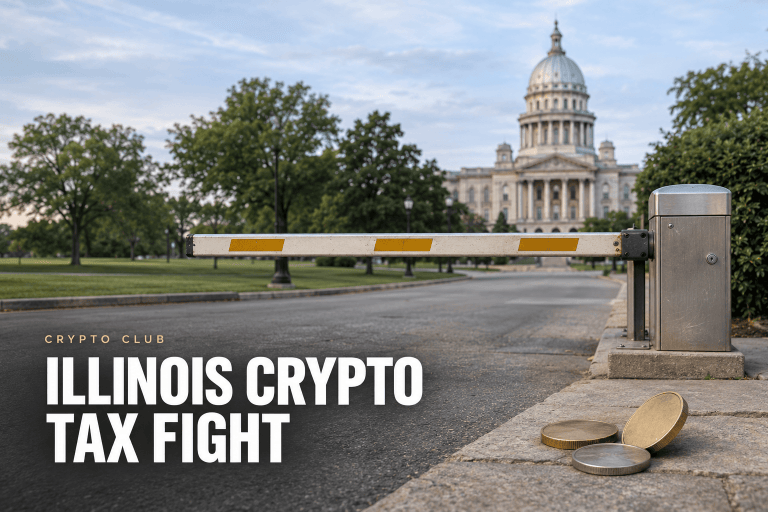

🏛️ What Illinois’ Crypto Tax Means for Users
Illinois is about to tax crypto in a way no other U.S. state has tried.

The Digital Asset Tax Act puts a 0.2% charge on the value of crypto when a broker exchanges, transfers, or stores it for an Illinois customer. It's not a tax on profit. A $10,000 trade owes $20 whether you made money or lost it, crypto.news explained.

Governor JB Pritzker signed the law in June as part of a larger revenue package, Senate Bill 3019. Law firm Jones Day called it the first state-level tax of its kind on digital asset transactions.

The stakes for firms are real. Jones Day's summary says noncompliance is a Class 3 felony.

It was meant to start January 1, 2027. In early October, state officials agreed in court to push the start to July 1, 2027, a change that needed a judge's sign-off.

Now the fight has moved to the fine print.
📜 What the Draft Rules Would Actually Tax
The Illinois Department of Revenue released draft rules on September 28. They spell out which everyday crypto moves count.

Stablecoins are in, even though they're built to hold a steady price. NFTs and tokenized securities are out.

Buying, selling, and converting crypto through a broker counts. So does bridging between blockchains when a broker charges a fee. Moving coins from an exchange to your own wallet can be taxed if the exchange charges a fee.

Some things stay clear. A direct transfer between personal wallets, with no paid middleman, isn't taxed. Gas fees paid to validators aren't treated as payment to a broker, and neither are swap fees that go only to liquidity providers.

Brokers carry the burden. Out-of-state firms with more than $100,000 in Illinois receipts a year must register, collect the tax, and file monthly returns, Holland & Knight noted.
⚔️ Why a16z and Uniswap Say It Bans DeFi
The comment period closed on October 30. That day, a16z, Uniswap Labs, and the DeFi Education Fund sent the state a letter. Their warning was blunt: the rules would effectively ban decentralized finance in Illinois, Bitcoin.com reported.

Their problem is the broker label. Under the draft, a decentralized exchange that collects protocol fees could be considered a broker.

But the groups argue that decentralized exchanges run on autonomous software. No one behind them can check who a user is, find out where they live, collect a tax, or file a return. They say asking them to do all four makes compliance impossible.

If the rules stand, the groups warn, the result may not be a tax bill at all. DeFi services could shut off for Illinois users.

Their requests were specific. Keep DeFi protocols and their front-end websites out of the broker definition. Stop taxing withdrawals to personal wallets and cross-chain bridges. And hold off until courts rule on whether the tax is legal.
🔑 The Private Key Problem for Crypto Holders
One part of the draft drew especially sharp objections.

The rules say broker records must be good enough to track asset movement, including account details and, in some cases, private keys, according to Holland & Knight's analysis. The law firm flagged the operational and cybersecurity concerns.

A private key is the secret that controls a crypto wallet. Whoever holds it can move the funds. That's why the A16Z, Uniswap, and DeFi Education Fund letter asked the state to replace private keys with public keys, which are safe to share.

Miles Jennings, a16z's head of policy, went further, comparing the tax on wallet withdrawals to taxing transfers between a person's own accounts.

For everyday holders, the point is practical. A rule meant to track taxes could create a pile of sensitive data that hackers target. The Binance theft, the largest on record, is a fresh reminder of how costly that can be.
⚖️ Lawsuits and a Repeal Bill Are Already in Play
The industry isn't waiting on comment letters alone.

The Digital Chamber and the Illinois Blockchain Association sued the state in July. The Blockchain Association and the Crypto Council for Innovation filed their own challenge in Sangamon County and asked for a preliminary injunction in September. Both argue the tax violates federal and state law. Those are claims, not rulings.

The delay to July 2027 came out of that legal fight, through a joint filing by the state and the challengers. It doesn't end the case. The challengers are still pressing their claims.

Other pieces are unsettled, too. As of late September, no court had blocked the law, a repeal bill called HB 5798 was still at the filing stage, and the department hadn't formally filed its draft rules, crypto.news reported.

That last part matters most right now. The comments the state just received could still reshape the final rules.
🎯 What Illinois Crypto Users Should Watch Next
Illinois' tax is small on paper, two-tenths of a percent. But it hits every covered move, not just profits, and it can reach stablecoins, wallet withdrawals, and bridges. For active traders, those charges stack up. Someone moving $50,000 a month through a covered broker would pay about $100 a month, gains or losses aside.

The bigger stakes are national. If Illinois makes this work, other cash-hungry states could copy it. If the courts strike it down, it becomes a warning.

Watch three things before July 2027. Whether the final rules keep decentralized exchanges and private keys in scope. How the court challenges play out. And whether lawmakers revisit the law.

For now, nobody in Illinois owes a cent of this tax. But traders there should start tracking their fees and the broker rules closely.
Sources
- https://tax.illinois.gov/content/dam/soi/en/web/tax/research/taxinformation/other/documents/digital-asset-tax-draft-proposed-rules-092826.pdf
- https://news.bitcoin.com/regulation-and-legal/a16z-uniswap-warn-illinois-crypto-tax-rules-ban-defi/
- https://en.bloomingbit.io/feed/news/123332
- https://crypto.news/illinois-explains-which-crypto-moves-face-0-2-tax/
- https://www.hklaw.com/en/insights/publications/2026/10/on-the-blockchain-gang-what-illinois-draft-digital
- https://www.jonesday.com/en/insights/2026/06/illinois-passes-nations-first-digital-asset-tax-heres-the-catch
- https://decrypt.co/379830/illinois-delays-controversial-crypto-tax
Crypto Club and Mode Mobile communications are for informational purposes only, and are not a recommendation, solicitation, or research report relating to any investment strategy, security, or digital asset. All investments involve risk including the loss of principal and past performance does not guarantee future results.
Any information contained in this commentary does not purport to be a complete description of the securities, markets, or developments referred to in this material. The information has been obtained from sources considered to be reliable, but we do not guarantee that the foregoing material is accurate or complete. There is no guarantee that any statements or opinions provided herein will prove to be correct.
Get fresh insights, breaking news, and hidden gems in the world of crypto—delivered straight to your inbox with our Crypto Cookies newsletter.

Don't miss out—sign up now and get your first bite of insider knowledge!