
🧪 A Live Bitcoin Test
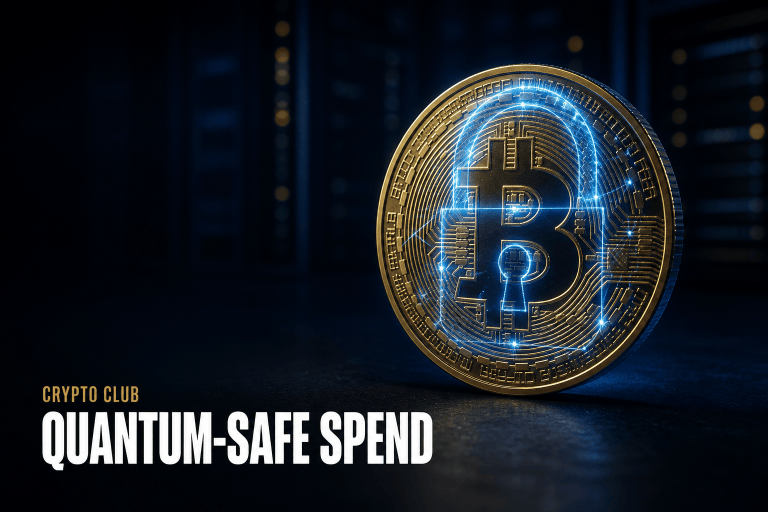
StarkWare says a quantum-safe Bitcoin spend was mined on mainnet on August 26, turning an April research proposal into a live demonstration. The result matters because it showed a holder can construct one kind of spend meant to resist a future attacker with a capable quantum computer, while using Bitcoin’s existing consensus rules. Independent coverage from The Block confirms the company described it as the first such transaction, and Unchained reported a 10,000-satoshi spend confirmed in block 964,199.
That is a concrete engineering milestone, but it is easy to overstate. Bitcoin did not adopt new cryptography, activate a soft fork, or become generally quantum-safe. A specific transaction construction cleared the network’s existing validation rules. For investors and operators, the news is better understood as evidence of a possible interim escape route for certain coins, not evidence that the protocol’s long-term quantum question has been settled.
🔐 The Exposure It Targets
Bitcoin signatures rely on elliptic-curve cryptography. A sufficiently capable quantum computer running Shor’s algorithm could, in principle, derive a private key from an exposed public key, undermining the assumption that makes an ordinary signature safe. StarkWare’s technical explanation focuses on a narrow but important moment: a conventional transaction reveals signing material and may sit publicly visible before a miner confirms it.
Many Bitcoin outputs are associated with a hash of a public key, so the key is not necessarily public before a spend. Once a transaction reveals it, however, a future quantum adversary could try to recover the private key and race a conflicting spend. QSB is designed to remove that particular opportunity. This is a forward-looking threat model, not a claim that today’s quantum machines can raid Bitcoin wallets. The useful distinction is between cryptography that is safe against known present-day attackers and cryptography designed for a more demanding future scenario.
⚙️ How The Workaround Works
The method, called Quantum-Safe Bitcoin or QSB, adds a hash-based protection layer alongside Bitcoin’s usual signature machinery. It uses signature grinding: before broadcast, the sender searches through transaction candidates until a transaction hash happens to meet the format Bitcoin will accept as a signature. The security of the resulting output is intended to rest on the difficulty of reversing a hash, rather than on the secrecy of an elliptic-curve private key. StarkWare credits the approach as drawing heavily on Levy’s QSB paper and Binohash work associated with BitVM creator Robin Linus.
The crucial point is compatibility, not magic. Bitcoin nodes can validate the result because the construction works inside rules already deployed. QSB does not use StarkWare’s STARK proving system, according to the company’s account. Nor does it replace Bitcoin’s signature scheme across the network. It instead creates a specially prepared spending path, with the expensive search performed offchain before the transaction reaches a miner.
⛏️ Why It Is Not Ordinary Bitcoin
The mainnet confirmation required unusual handling. QSB transactions are nonstandard, meaning ordinary nodes will not propagate them through the public mempool in the normal way. StarkWare says the team submitted this spend directly to a miner through MARA’s Slipstream service. That path is material to the claim: it proves the transaction can be mined, but it does not show a typical wallet user can broadcast one through everyday Bitcoin infrastructure.
There is also a price. StarkWare puts the current offchain computational cost at several hundred dollars, while The Block’s report notes that generating a transaction can take hours. That makes QSB a poor fit for routine payments and a more plausible contingency tool for high-value, carefully prepared moves. It also cannot rescue an output whose public key was already exposed before the transaction was created, because a quantum attacker would have had time to target that key. The workaround is selective by design.
🧭 The Protocol Work Still Ahead
StarkWare itself presents QSB as a bridge, not an endpoint. Its announcement says a soft fork remains the preferable long-term route, because a network-level migration could establish standardized quantum-resistant spending methods rather than relying on costly, nonstandard transactions and direct miner relationships. That framing is consistent with the company’s comments reported by The Block: a lifeboat is useful, but it is not a substitute for improving the ship.
Any protocol change would involve more than selecting a new algorithm. Bitcoin would need compatible wallet behavior, clear migration paths for old outputs, infrastructure support, and broad agreement about tradeoffs. The practical timeline is uncertain because the timing and capability of cryptographically relevant quantum computers are uncertain. That is precisely why an interim method has value: it expands the set of options while the harder coordination work remains unresolved. It should not be read as eliminating that work.
📊 What Investors Should Watch
This transaction shifts the discussion from whether a no-fork workaround is possible to where it is useful. Watch for repeatable independent demonstrations, whether more miners and wallet tooling support direct submission, changes in grinding cost, and serious proposals for a standardized protocol upgrade. The first confirmation is a proof of feasibility, not proof of scale, usability, or broad security coverage.
For Bitcoin holders, the near-term takeaway is measured. There is no indicated need to treat an ordinary wallet as instantly compromised, and there is no basis to call Bitcoin quantum-safe after one mined transaction. But the demonstration shows that some holders may have a technical option before a consensus change arrives, provided their coins fit the method’s limits and they can use the required infrastructure. That is meaningful resilience research. It is not an investment signal or a reason to stop demanding careful protocol-level preparation.
Sources
– https://starkware.co/blog/the-first-quantum-safe-bitcoin-transaction-has-been-mined/
– https://www.theblock.co/news/defi/2026-08-26-first-quantum-resistant-bitcoin-transaction-starkware-412863
– https://unchainedcrypto.com/starkware-executes-first-quantum-safe-bitcoin-transaction-on-mainnet/
– https://github.com/avihu28/Quantum-Safe-Bitcoin-Transactions/blob/main/paper/QSB.pdf
Crypto Club and Mode Mobile communications are for informational purposes only, and are not a recommendation, solicitation, or research report relating to any investment strategy, security, or digital asset. All investments involve risk including the loss of principal and past performance does not guarantee future results.
Any information contained in this commentary does not purport to be a complete description of the securities, markets, or developments referred to in this material. The information has been obtained from sources considered to be reliable, but we do not guarantee that the foregoing material is accurate or complete. There is no guarantee that any statements or opinions provided herein will prove to be correct.
Get fresh insights, breaking news, and hidden gems in the world of crypto—delivered straight to your inbox with our Crypto Cookies newsletter.
Don’t miss out—sign up now and get your first bite of insider knowledge!