
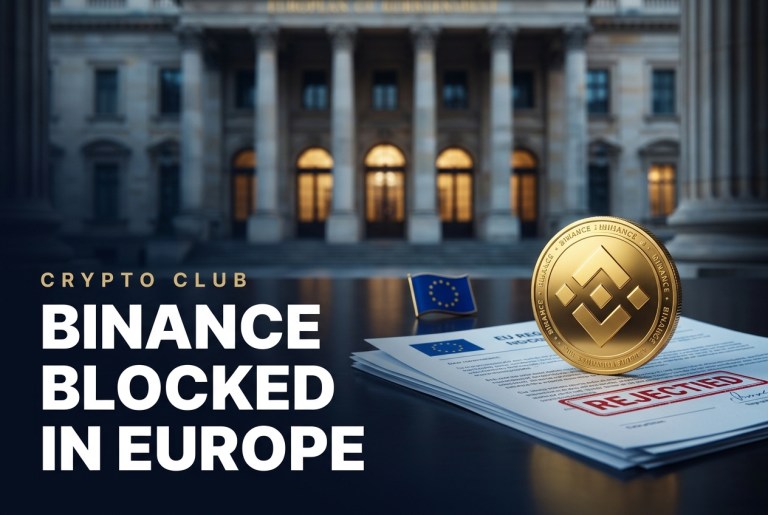

🚧 Greece Slams the Door on Binance’s MiCA Application
The world’s largest crypto exchange is facing a major regulatory setback in Europe. Greece’s Hellenic Capital Market Commission (HCMC) is reportedly poised to reject Binance’s application for a Markets in Crypto-Assets (MiCA) license, according to reporting from Reuters. The timing is striking: the application had already cleared most of the HCMC’s internal review process, with the commission’s anti-money laundering officer on record as having given a favorable opinion, and the standard 40-day review window closing on June 4 with no objections raised at the European level. By any ordinary measure, the application was on track. What changed, according to multiple reports, was not the application’s content but the political environment surrounding it. The abrupt reversal from apparent approval to near-certain rejection suggests the decision was driven by forces beyond Greece’s domestic regulatory process.
🏛️ Christine Lagarde’s Shadow Over the Decision
European Central Bank President Christine Lagarde is now at the center of this story. Reports indicate that Lagarde signaled to Greek Prime Minister Kyriakos Mitsotakis, during a meeting in May, that Binance was not welcome in Europe. Her concerns reportedly center on two areas: Binance’s significant influence across the European crypto market, and the exchange’s exposure to stablecoins. The ECB has been vocal about stablecoin risks for months, arguing that large-scale private stablecoin adoption could draw retail savings away from commercial banks, weaken monetary policy transmission, and compete directly with the ECB’s own digital euro ambitions. Whether or not Lagarde’s intervention was coordinated policy or informal pressure, the outcome is the same: a fully compliant application is being denied on what industry observers are calling political rather than regulatory grounds.
⏳ The MiCA Deadline Is Closing Fast for the Entire Industry
The stakes here extend far beyond Binance. Under MiCA, all crypto-asset service providers that want to serve customers across the European Union’s 27 member states must hold a formal authorization before the transitional period ends on July 1, 2026. There are no extensions. The European Securities and Markets Authority confirmed in April 2026 that the date is fixed and binding on all member states simultaneously. The broader picture is sobering: roughly 83% of crypto firms that once held national VASP registrations across the bloc have not yet converted to full MiCA authorization. Of the 1,200-plus firms that previously held national licenses, only about 210 have secured full CASP status, and just 14 trading platforms have cleared the bar. The MiCA framework was designed to create a single passport for crypto firms across the EU, but it is increasingly looking like a high-stakes filtering process that most players are failing to clear in time.
🇫🇷 France Becomes Binance’s Final Realistic Option
With Greece now effectively closed, attention has shifted to France as the last viable path to an EU-wide MiCA license before the deadline. Binance has maintained a Digital Asset Service Provider registration with France’s Autorite des Marches Financiers (AMF) since May 2022, which covers custody and spot trading on a domestic basis. That existing relationship gives Binance a foothold, but a full MiCA application in France has not yet been filed. The French path is also not without friction: France’s banking regulator, the ACPR, is currently conducting extensive anti-money laundering inspections on registered crypto firms including Binance, as a prerequisite for full MiCA upgrade. So far only four entities in France have been approved for the full license, signaling that the AMF’s bar is high.
📉 What EU Customers and BNB Holders Are Watching
For Binance’s European user base, the stakes are concrete. If no MiCA license is secured before July 1, Binance could be forced to restrict or fully exit services across the EU, affecting millions of customers in one of the world’s largest economic blocs. BNB, Binance’s native token, already felt the pressure: the token dropped over 3% to around $588 following the Greece rejection reports, with futures open interest falling approximately 4% to $873 million. Markets are pricing in meaningful risk. For retail traders holding BNB or assets on Binance’s EU-facing platforms, the next few weeks are a genuine watch period. Any formal announcement of a France application, or any signal from the AMF that talks are progressing, could shift sentiment quickly in either direction.
🎯 The Bigger Picture: Regulation as Competitive Policy
The Binance-Greece situation raises a question worth sitting with: when regulatory bodies are influenced by central bank executives worried about stablecoin competition, is that regulation or industrial policy? The ECB has been open about viewing private stablecoins as a structural threat to European monetary sovereignty, and the push toward a digital euro by 2026 gives it a direct institutional interest in limiting which private players gain EU-wide scale. For investors, the lesson is familiar: in heavily regulated markets, the risk is not just market volatility but political risk baked into the licensing process itself. Watching whether Binance files in France, and how quickly French regulators respond, will tell investors a great deal about whether the EU crypto market remains open for business or increasingly curated by central bank preferences.
Crypto Club and Mode Mobile communications are for informational purposes only, and are not a recommendation, solicitation, or research report relating to any investment strategy, security, or digital asset. All investments involve risk including the loss of principal and past performance does not guarantee future results.
Any information contained in this commentary does not purport to be a complete description of the securities, markets, or developments referred to in this material. The information has been obtained from sources considered to be reliable, but we do not guarantee that the foregoing material is accurate or complete. There is no guarantee that any statements or opinions provided herein will prove to be correct.
Get fresh insights, breaking news, and hidden gems in the world of crypto—delivered straight to your inbox with our Crypto Cookies newsletter.
Don’t miss out—sign up now and get your first bite of insider knowledge!